Product Designer turning complex user journeys into measurable business impact — across web and mobile.

Based in Berlin · Driving conversion and UX at Invia Flights ✈️


SELECTED WORK

Other Notable Work

Flex Ticket Feature
Flex Ticket Adaptation
Adapted the established Flex Ticket pattern (used by platforms like GetYourGuide and Booking.com) to fluege.de specific insurance partnerships. Solo-designed the integration into the booking flow across Web, iOS and Android within a focused two-week sprint.
Booking FlowInsurance PartnershipsPattern Adaptation
Enterprise Design System
Enterprise Design System Foundation
Led the design system foundation work for an enterprise B2B platform, including a unified icon system, the migration from Adobe XD to Figma and the rebuild of core UI components, tokens and typography.
Design SystemsDesign TokensTool Migration

Growth & Content Experiment

3,000+ followers · 1M+ views (2 months)

I use this channel to test:

  • retention & hook optimization

  • content structure & storytelling

  • performance-driven iteration

Designing a clearer and more scalable esports competition platform.

Who I am?

Product Designer based in Berlin with a focus on conversion-driven product experiences and scalable systems.
I work across web and mobile (iOS & Android), using KPIs, A/B testing and user insights to improve complex user journeys.
My experience spans e-commerce, enterprise and gaming platforms, where I design and optimize products with a strong focus on measurable impact.


Let’s connect

I’m currently open to new opportunities in Product Design and UX.If you’re building meaningful products and looking for someone focused on conversion, mobile UX and measurable impact, feel free to reach out.

Designing a post-booking price guarantee.

Smart Price Guarantee at Invia Flights, turning post-purchase wait time into user value.

Designing a clearer and more scalable esports competition platform.

MY ROLE

RoleLead Product Designer
Team1 Business Ops · 3 Devs · 1 QA
ScopeWeb · iOS · Android

I owned the end-to-end concept and design of Smart Price Guarantee, an intelligent post-booking feature that turned the gap between booking and ticket issuance into measurable user value. As Lead Product Designer, I drove the concept from initial idea through cross-platform implementation across Web, iOS and Android, in close collaboration with Business Operations and a dedicated engineering team.

  • Concept ownership from initial product idea to validated production design

  • Cross-platform interaction design (iOS HIG, Material Design, responsive Web)

  • User research and behavioral validation to test trust and clarity of the offer

  • Close collaboration with Business Ops and Engineering on the price-tracking logic

Product InnovationTrust UXCross-Platform DesignBooking Funnel UX

CONTEXT

Invia Flights is one of the largest OTA providers in the german market, serving customers on Web, iOS and Android under different brands like fluege.de or airline-direct.de
Like all consolidated booking platforms, Invia operates with a structural delay between booking and ticket issuance, ranging from 1 to 3 days depending on airline and booking type. This delay is well known to users and is a common industry-wide friction point.

Designing a clearer and more scalable esports competition platform.

THE PROBLEM

Users knew about the 1 to 3 day issuance delay, but they had no way to act on it. If a flight became cheaper in those days, the saving simply went to the airline, never to the customer who already paid the higher price.
This created a quiet but persistent trust issue:

"Why book now if the price might drop tomorrow?"

  • Customers felt locked into a price they couldn't influence

  • Price-watching behavior shifted attention to competitors

  • The post-booking phase was perceived as dead time, not value time

  • Trust was leaking at exactly the moment we needed it most

The challenge was clear: turn a known industry frustration into a competitive trust advantage.


DISCOVERY & MARKET POSITIONING

Before designing the feature, I conducted a competitive analysis across DACH and international flight booking platforms to understand how the industry was handling price uncertainty.
The pattern was consistent: most competitors offered pre-booking price watch tools that notified users when prices dropped, leaving the burden of timing on the customer. Some required insurance products to recover savings. None solved the problem after the booking was already made.

Strategic insight:

Instead of helping users decide when to book, we could help them stop worrying once they had booked. The problem wasn't pre-booking timing, it was post-booking trust.

This reframe became the foundation of Smart Price Guarantee: an automatic, insurance-free, in-the-background mechanism that turned the 1 to 3 day issuance window from a vulnerability into a value proposition.


KEY IMPROVEMENTS

Smart Price Guarantee Opt-in Moment
Opt-in at the right moment
Designed the in-funnel opt-in to appear at the exact decision moment, framed as an automatic safeguard rather than an upsell. The placement, copy and visual weight were calibrated to feel like a service, not a sales pitch.
Trust UX Elements
Building trust without selling
Used transparent language, clear mechanics and zero insurance jargon. Every UI element answered the unspoken user question: "What's the catch?"
Cross-platform consistency
Native consistency across platforms
Adapted the feature to iOS HIG, Material Design and responsive Web while keeping the trust mechanics identical. Same logic, three platform-native expressions.

IMPACT

Outcome

Smart Price Guarantee achieved adoption rates significantly above industry benchmarks for opt-in features in flight booking funnels, validating the core hypothesis that post-purchase trust outweighs pre-purchase price-watching behavior.

The feature drove measurable improvements in customer satisfaction, with post-launch surveys showing increased NPS and users specifically citing the price guarantee as a reason for trust in the platform.Internally, Smart Price Guarantee was celebrated company-wide as a flagship feature in All-Hands meetings, recognized as a successful example of turning industry friction into competitive advantage.

LEARNINGS

1. Trust UX requires zero compromise

When users see something that sounds too good to be true, transparency isn't a nice-to-have, it's the entire product. Every word of copy, every UI element and every flow had to answer "what's the catch?" before users asked it.

2. Native consistency means translating, not copying

Same logic, same trust mechanics, three platform-native expressions. iOS, Android and Web each had their own visual language and interaction patterns, but the user feeling had to be identical. Cross-platform design isn't visual matching, it's emotional matching.

3. Competitive analysis as strategic discovery

Without classic user research available, market analysis became the foundation for product strategy. Looking at what competitors weren't doing turned out to be more valuable than copying what they were.


Improving an Esports Platform Experience

Designing a clearer and more scalable esports competition platform.

Designing a clearer and more scalable esports competition platform.

MY ROLE

RoleUX Designer / Product Designer
Team1 UI · 1 PM · 3 Devs
Scope4 Platforms · 50,000+ Users/Season

As the UX & product designer across 4 esports products serving 50,000+ users per season in the DACH region, I owned the full design process from research to shipped product. I drove key IA and product decisions in close collaboration with the team.

  • User research and behavioral analysis (Hotjar&GA) to identify key drop-off and navigation issues

  • Information architecture redesign to unify 4 fragmented product experiences

  • Interaction design and prototyping across web and mobile

  • Usability testing with real players to validate and iterate on key flows

Platform UXInformation ArchitectureData VisualizationProduct Feature Design

CONTEXT

Prime League is one of the largest League of Legends competitions in the DACH region, with 1,500+ teams and 6,000+ registered players per season.
The platform serves three fundamentally different user groups:

  • Players: registrations and schedules

  • Teams: standings and opponent data

  • Spectators: brackets and live results

The same infrastructure powered 99Damage League and DreamHack Leipzig, making consistency across products a core design challenge.

Designing a clearer and more scalable esports competition platform.

THE PROBLEM

As the platform grew across 4 products, the experience became increasingly fragmented.

"When and where is my next match?"

Navigation was built around league data models, not user intent. Users struggled to:

  • Understand tournament structures

  • Follow match progress

  • Explore team data and historical performance

  • Navigate between leagues, seasons and matches


RESEARCH & DISCOVERY

I combined four research methods: Hotjar behavioral analysis, Maze tests, moderated usability sessions and card sorting with 25 participants.
Hotjar behavioral analysis, unmoderated Maze tests, moderated usability sessions and card sorting with 25 participants.
Hotjar revealed users were scrolling past key navigation. Usability testing surfaced the core problem: newcomers couldn't answer "When and where is my next match?"Usability testing surfaced a deeper problem: newcomers to the platform couldn't answer a basic question from the interface: "When and where is my next match?"
The bracket structure was built around league data models, not around what players actually needed to know.

Key Insight

Card sorting confirmed users grouped content around match intent, not league structure. This drove our most critical IA decision: shifting from liga-first to match-first navigation.

The platform ecosystem included
multiple interconnected features:

  • league registrations

  • tournament brackets

  • team profiles

  • match tickers

  • live stream integration

  • league tables and matchdays

Improving the experience required restructuring how this information was organized and presented across the platform.

Designing a clearer and more scalable esports competition platform.

The original structure is driven by league data models.
This redesign shifts navigation toward user intent: competing, watching, and exploring.


KEY IMPROVEMENTS

Information Architecture Diagram
Information Architecture
Restructured navigation hierarchy from liga-first to match-first across 8 competitions.
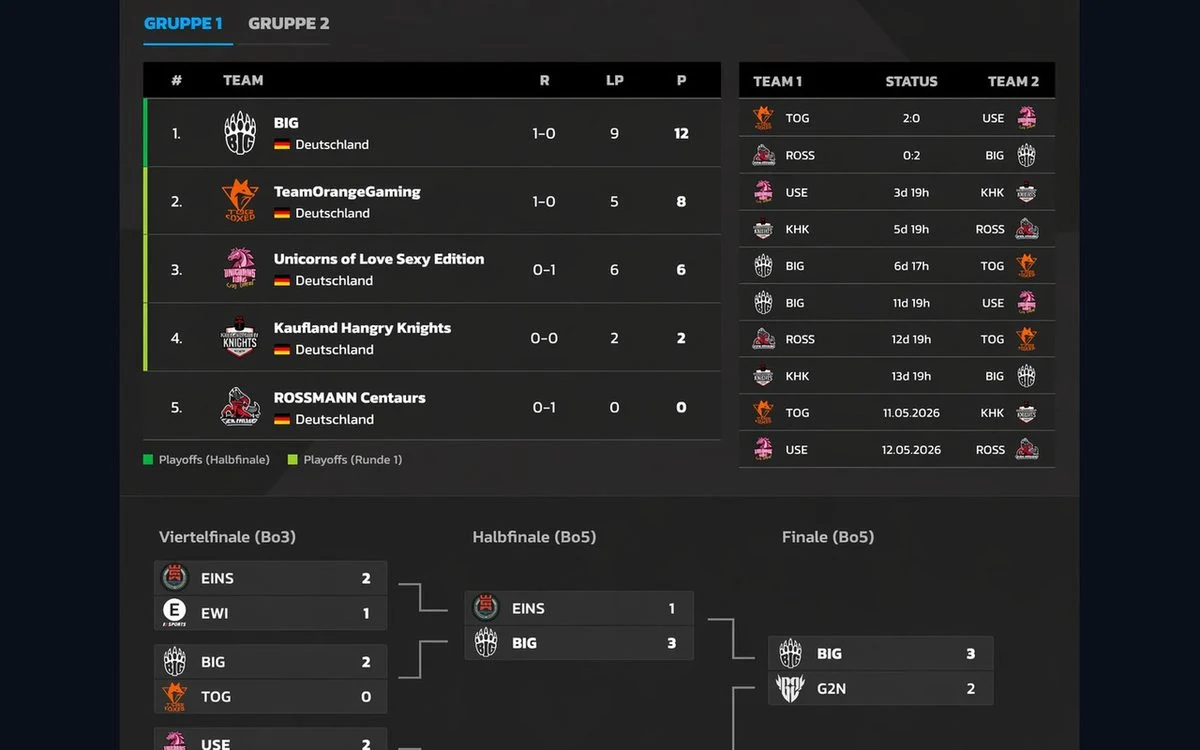
Tournament Bracket Redesign
Tournament Brackets
Redesigned brackets and league tables to clearly communicate competition progress.
Team Profile Pages
Team Profiles & History
Enhanced team pages with historical performance data across seasons.
Ecosystem Features
Ecosystem Features
Live stream visualization, match ticker, MVP transfer market and participant lists.

IMPACT

30%
Reduced registration drop-off after redesigning the onboarding flow based on usability testing with 25 participants
40%
Reduction in development workload through shared component library across Prime League, 99Damage and DreamHack Leipzig
10%
Growth in active users through redesign of core platform features including brackets, navigation and match tracking
NPS +
Restructured tournament navigation validated through post-launch user surveys showing improved satisfaction scores

LEARNINGS

1. Data beats assumptions

As a designer, I assumed the navigation problems were visual. Hotjar recordings proved otherwise: users knew where to look, they just couldn't predict what they'd find there.
That shift from gut feeling to behavioral evidence changed how I approach every problem since.

2. Three user groups means three truths

Players, teams and spectators used the same platform with completely different mental models. Early in the project I was designing for one generic 'user'.
Usability testing forced me to separate those perspectives, and the registration drop-off reduction of 30% was a direct result of that shift.

3. Set quantitative benchmarks from beginning

Looking back, I would have defined success metrics before the redesign, not after. We measured impact retrospectively.
Setting a baseline NPS or task-completion benchmark upfront would have made the outcome story significantly stronger.